
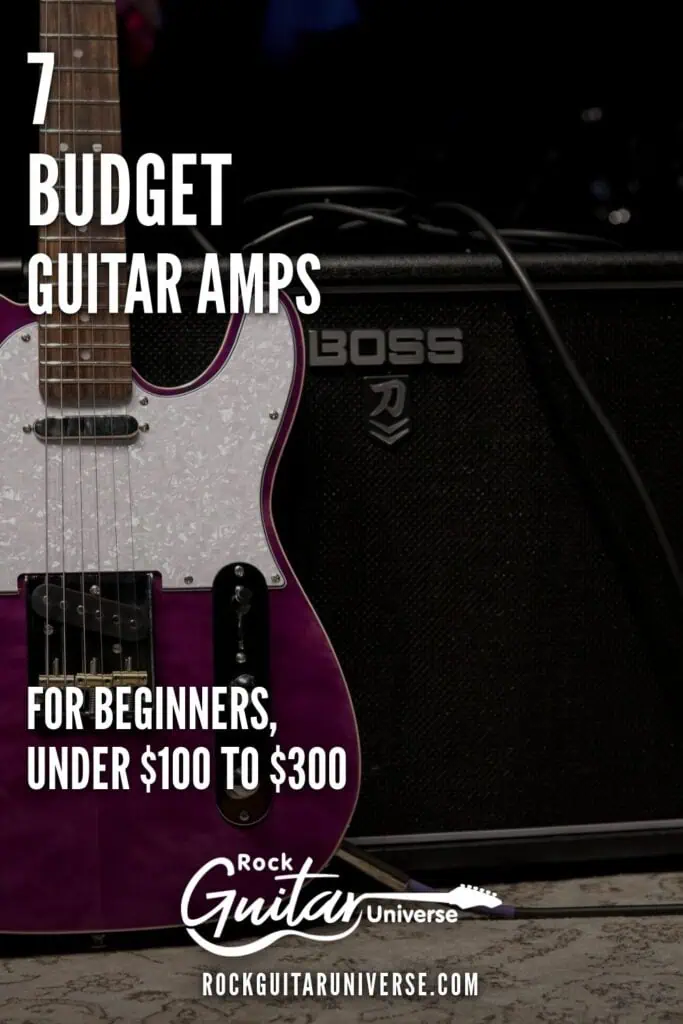
If you want one answer, buy the Fender Mustang LT25. It’s cheap, it has a tuner and plenty of sounds built in, it works with headphones, and it’s the amp most beginner guides land on.
This page used to list 20 amps. When I went back through it in October 2026, half of them had been discontinued or replaced, so I cut it down to the seven I’d actually spend money on. Each one is here for a different reason, and each one has a demo so you can hear it before you buy.
The Quick Picks
| Amp | Best for | Power | Price |
|---|---|---|---|
| Fender Mustang LT25 | Most beginners | 25 W | Under $200 |
| Fender Frontman 10G | The tightest budget | 10 W | Under $100 |
| Orange Crush 12 | Rock tone with no menus | 12 W | Under $150 |
| Positive Grid Spark GO | Headphones and practicing anywhere | 5 W | About $150 |
| Boss Katana Mini X | Battery power that still sounds big | 10 W | Under $200 |
| Blackstar Fly 3 | A desk or a bedside table | 3 W | About $100 |
| Fender Champion II 50 | Playing with a drummer | 50 W | About $250 |
Prices are typical music store prices in late 2026 and they move around, so click through for today’s price.
How I Picked These
I didn’t test these seven in a studio. I went through the current reviews from Guitar World, Guitar Player and guitar.com, the makers’ own spec sheets and a lot of owner reviews, and then threw out anything that’s no longer made, anything over $300, and anything that does the same job as a better pick. What’s left covers the different ways a beginner actually plays: quietly at home, with headphones late at night, on the go, and eventually with other people.
1. Fender Mustang LT25: Best For Most Beginners

The safe choice. It does everything a first amp needs to do, and a few things you’ll grow into.
✔ Good for: a first amp, home practice, trying lots of sounds without buying pedals
✘ Skip it if: you plan to play with a drummer soon, since 25 watts won’t keep up
• Key specs: 25 watts, 8 inch speaker, 30 preset sounds, tuner, headphone jack, USB for recording, 12.75 lb
The LT25 is a modeling amp, which means it copies the sound of other amps and effects digitally. You get 20 amp models and 25 effects, and the 30 presets it ships with go from clean country to heavy metal. You scroll through them on a small color screen and turn one knob to pick. That matters more than it sounds, because a beginner who can find a good sound in ten seconds plays more.
It also has a tuner built in, a headphone jack for quiet practice and an aux input so you can play along with songs from your phone. The USB port lets you record straight into a computer.
The one real limit is volume. It’s plenty loud for a bedroom, but once a drummer joins you’ll need the Champion II 50 further down this list.
2. Fender Frontman 10G: Best Under $100

The cheapest amp I’d buy. Simple, light, and it has the two jacks a beginner needs.
✔ Good for: the smallest budget, a kid’s first amp, a spare amp for the living room
✘ Skip it if: you want reverb or effects, because it has none
• Key specs: 10 watts, 6 inch speaker, clean and overdrive, headphone jack, aux input, 8.5 lb
There’s nothing to learn on the Frontman 10G. Four knobs (gain, volume, treble, bass) and one button that switches between a clean sound and a dirty one. Plug in and play.
It sounds like what it is, a small practice amp with a 6 inch speaker, and the overdrive is mild rather than heavy. But it has the two things a beginner needs most: a headphone jack and an aux input. If money is tight, this is where I’d start, and you can always add an overdrive pedal later.
3. Orange Crush 12: Best For Rock Tone With No Menus

For the beginner who just wants a great crunchy rock sound and nothing to scroll through.
✔ Good for: rock, punk and blues, players who hate menus, quiet distortion at home
✘ Skip it if: you need reverb, delay or clean country sounds with effects
• Key specs: 12 watts, 6 inch speaker, gain and overdrive knobs, 3 band EQ, headphone output with a speaker simulator
The Crush 12 is all analog, which means no digital models, just a small amp voiced to sound like a big Orange. Turn up the gain and overdrive knobs and you get thick rock distortion, even at low volume, because the volume knob works as a master.
The headphone output is better than most at this price. It copies the sound of a miked Orange 4×12 cabinet, so headphones don’t sound thin and buzzy. The catch is that there’s no reverb and only one channel, so it’s a rock amp first and everything else second.
4. Positive Grid Spark GO: Best For Headphones And Practicing Anywhere

A pocket sized amp that sounds best in headphones and doubles as a Bluetooth speaker.
✔ Good for: late night practice, apartments, travel, playing along with songs through the app
✘ Skip it if: you want an amp to fill a room, because 5 watts through a 2 inch speaker won’t
• Key specs: 5 watts, 2 inch speaker, 33 amp models and 43 effects through the free app, up to 8 hours on battery, about 0.8 lb
The Spark GO is smaller than a paperback book. Through its own speaker it’s a desk toy. Through headphones it’s a serious practice amp, with dozens of amp and effect sounds you set up in the Spark phone app.
The app is the real reason to buy it. It can stream a song from your phone through the amp so you play along, and it has practice tools built in. It also works as a plain Bluetooth speaker when you’re not playing. If you want the same idea with a bigger speaker, read my Positive Grid Spark 40 review.
5. Boss Katana Mini X: Best Battery Amp

The battery amp that sounds most like a real one. Take it to the porch, the park or a friend’s house.
✔ Good for: playing anywhere without a power socket, busking practice, a second amp
✘ Skip it if: you want lots of presets and an app to tweak them
• Key specs: 10 watts, 5 inch speaker, clean, crunch and brown channels, reverb, delay and modulation, about 10 hours on its rechargeable battery, 6 lb
Boss’s big Katana amps are some of the most recommended in the world, and the Mini X squeezes three of their sounds into a box you can carry by the strap. Each of the three channels has a second variation, so you really get six sounds, plus two effect sections that can run at the same time.
The battery is built in and charges in about three hours from a USB charger rated 5 V and 2 A or more. It also streams music over Bluetooth, so you can play along with songs. It costs more than the Frontman, but it’s the one I’d pick if you won’t always be near a wall socket.
6. Blackstar Fly 3: Best Tiny Desk Amp

Small enough for a bedside table, with a delay effect most cheap amps don’t have.
✔ Good for: a desk, a dorm, a cheap second amp that runs on AA batteries
✘ Skip it if: you want a sound that fills a room
• Key specs: 3 watts, 3 inch speaker, clean and overdrive channels, tape delay, headphone and line output, runs on 6 AA batteries or a power supply sold separately
The Fly 3 has been around for years because it does one thing well: it’s a real little amp that fits on a desk. You get a clean and an overdrive channel, Blackstar’s ISF knob that moves the tone from an American to a British sound, and a tape style delay for a bit of space.
It runs on six AA batteries, and the power supply is sold separately, which is worth knowing before you order. Blackstar also sells a matching speaker, the Fly 103, that turns it into a small stereo setup.
7. Fender Champion II 50: Best For Playing With A Drummer

The one to buy if you’ll be jamming with friends, because it’s loud enough to keep up.
✔ Good for: band practice, playing with a drummer, a first amp you won’t outgrow
✘ Skip it if: you only ever play quietly at home, where it’s more amp than you need
• Key specs: 50 watts, 12 inch speaker, two channels, reverb, delay, chorus and tremolo, tap tempo, headphone jack, USB, 19 lb
This is the biggest amp here and the only one that can hold its own against a drummer. When guitar.com reviewed it in January 2025 they gave it 8 out of 10 and called it a hugely impressive option for beginners.
It’s simpler than the Mustang. Two channels, a knob that picks between four amp voicings (classic Fender, modern Fender, British and high gain), and one knob for effects with a tap switch to set the delay to the song’s tempo. The 12 inch speaker is what makes it sound like a real amp in a room. A footswitch for changing channels is sold separately, and there’s no effects loop, which only matters once you own a pile of pedals.
How To Choose A Cheap Amp
- Watts and drummers. For home practice, 10 to 25 watts is plenty. If you’ll play with a drummer, look at 50 watts and a 12 inch speaker.
- A headphone jack is a must. Every amp on this list has one. It’s the difference between practicing at 11pm and not practicing.
- Simple or modeling. Simple amps like the Frontman and the Crush are quick to use. Modeling amps like the Mustang and the Spark give you many more sounds, but you’ll spend some time in menus.
- Batteries. If you’ll play away from a socket, the Katana Mini X, Spark GO and Fly 3 all run on batteries.
What About Amps Under $50?
I left them out on purpose. Under about $80 you get a tiny speaker and a harsh sound, and that makes practicing less fun, not more. If $50 is the real limit, buy a headphone amp instead. It plugs straight into your guitar and sounds better through headphones than a cheap speaker does.
And if you’re curious about tubes, they cost more than this list allows. My page on small tube amps for home starts where this one stops.
Good luck and keep on rockin’!
Buying your first guitar?
Get my free 19 page guide, Guitar Gear Essentials, with an eight point checklist to take to the store.
Recent Posts
D, G and A are the I, IV and V chords of D major. Wikipedia lists the notes of D major as D, E, F#, G, A, B and C#, so D is the 1st note, G the 4th and A the 5th. Its page on three chord songs says...
Guitar Pro costs $69.95, and its free trial lasts seven days. You don't need it to write tabs. TuxGuitar opens Guitar Pro files from version 1 to 7 and costs nothing, and it's only the first of...