
You tuned to DADGAD, strummed the open strings and loved that big ringing sound. Then you tried your usual G or C shape and it sounded wrong. MusicRadar puts it well: after the retune, “all those chord shapes you spent hours learning have new sounds.”
Finding the new shapes online is harder than it should be. Guitar Gear Finder warns that a lot of the D major diagrams posted for DADGAD are wrong, because they leave out the F# that makes the chord major. Others give sus and add chords plain names like G or Em, so you learn a shape under the wrong name.
The chart below gives you 10 easy shapes, each named after the notes it really plays. After it come the retuning steps, the D, G and A chords, a one finger I, IV and V, the minor chords, shapes that move up the neck, three progressions and a few famous songs in DADGAD. Every chord box on this page also comes as a free two page PDF.
Would you rather learn through songs than theory? My book, From First Chord to First Solo, adds a chord or two in each chapter, each with a real song to play, all the way to your first solo.
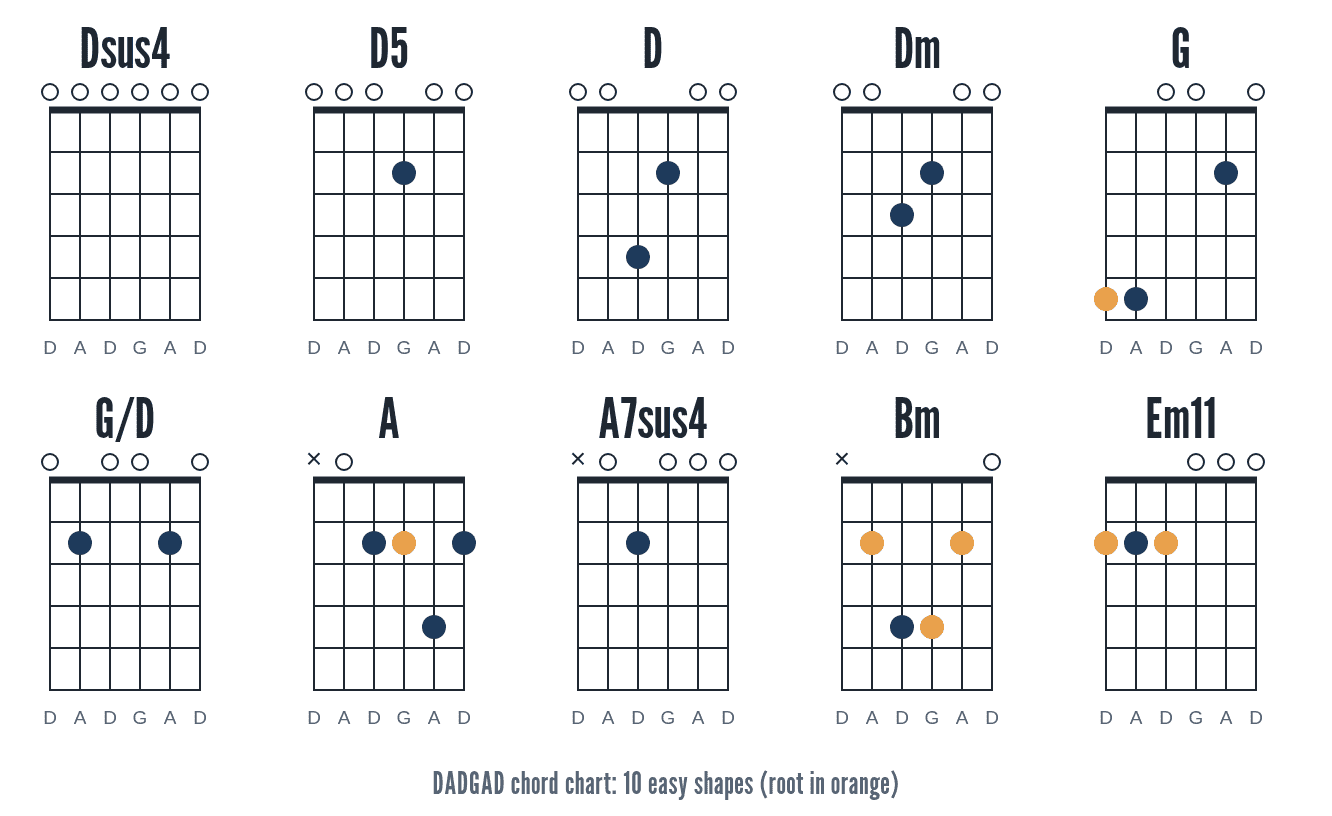
In a hurry? Here are the 10 shapes from the chart and the notes each one plays. Frets are written from the low D string to the high D string; x means don’t play the string, 0 means open.
| Chord | Frets, low to high | Notes |
|---|---|---|
| Dsus4 | 000000 | D A D G A D |
| D5 | 000200 | D A D A A D |
| D | 004200 | D A F# A A D |
| Dm | 003200 | D A F A A D |
| G | 550020 | G D D G B D |
| G/D | 020020 | D B D G B D |
| A | x02242 | A E A C# E |
| A7sus4 | x02000 | A E G A D |
| Bm | x24420 | B F# B B D |
| Em11 | 222000 | E B E G A D |
The free PDF puts every chord box from this page on two printable pages, sorted into five groups: D chords, the one finger I, IV and V, G and A, minor chords and moving shapes.
How To Read The DADGAD Chord Chart

Each box is one chord, drawn as if the guitar stood upright facing you. The thick bar at the top is the nut, the low D string is on the left, and the string names run along the bottom: D A D G A D. Dots are fingers, and the orange dot is the chord’s root. A circle above a string means play it open; an x means leave it out. The boxes show the first five frets, so the two low dots of the G sit on the 5th fret.
Start with no fingers at all. Strummed open, the six strings make a Dsus4 chord, “a big, bold Dsus4 chord” in Guitar World’s words. Guitar Gear Finder counts three D strings, two A strings and one G string. There’s no F or F# in there, so the open tuning is neither major nor minor; as Martin Simpson tells Guitar Player, “you can go either way.”
That’s why your fretted notes matter. The Acoustic Guitarist explains that a major or minor chord needs a third, so one finger in the right place decides the mood. The open strings also add extra notes, which is why some names here run long, like Em11 or A7sus4: I named each chord after everything it plays.
How To Tune Your Guitar To DADGAD
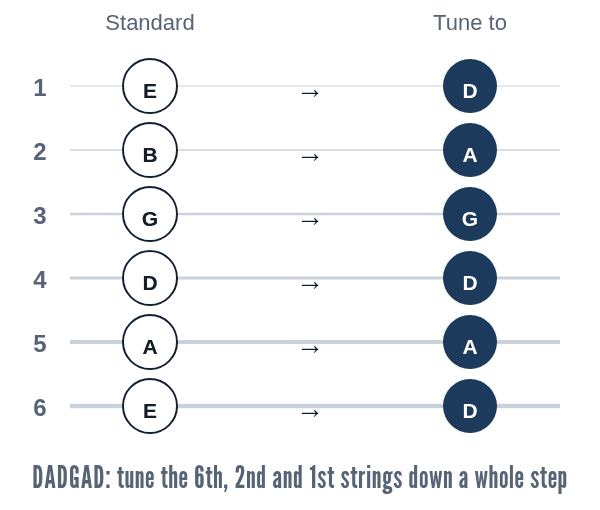
Only three strings move. The Acoustic Guitarist’s recipe: from standard tuning, lower strings 6, 2 and 1 (the low E, the B and the high E) a whole step each, which is two frets. The A, D and G strings stay as they are. Martin Simpson’s way of putting it is that “50 percent of this tuning is completely familiar to you.”
Tune down, never up. Your Guitar Academy points out that every change goes down from standard, so you don’t risk snapping a string. By ear, pickuptheguitar’s method is to play the low E with the open D string and lower it until the two match, an octave apart, then do the same with the B against the open A and the high E against the open D. MusicRadar’s advice is shorter: “Use a tuner. It’s not cheating!”
Guitar World credits British folk guitarist Davey Graham with bringing the tuning back from Morocco, where, Wikipedia says, he heard an oud player. The Guardian dates his first use to She Moved Through the Fair in 1963; Wikipedia dates his live recording of it to 1964. If you’ve ever wondered why standard tuning is EADGBE in the first place, I covered that in why guitar strings are tuned as EADGBE.
JustinGuitar’s lesson on the retune runs just over 3 minutes:

The D Chords: Dsus4, D5, D, Dm And D7
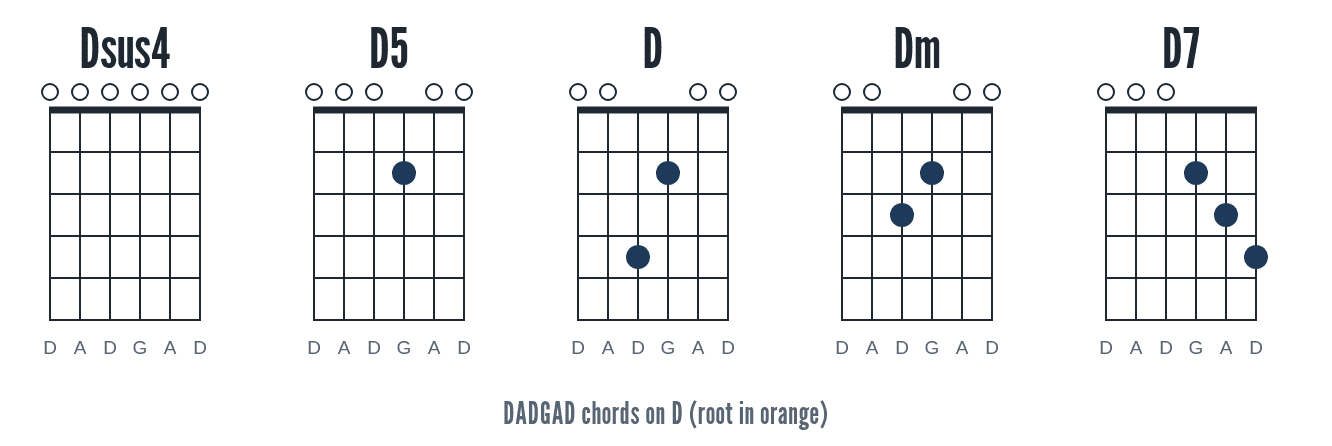
D is home in this tuning. Fundamental Changes notes that DADGAD music is often in D major or D minor, and Guitar World says the tuning “encourages you to stick to the key of D.”
The easiest one hides a trap. Put one finger on the 2nd fret of the G string, 000200, and you get D A D A A D: a D5 power chord with no F#. Beginner Guitar HQ labels this shape D, though its own text says it’s a power chord. Guitar Gear Finder’s rule clears it up: “The note F# is what makes a D chord a D Major chord.” The good news, from Fundamental Changes, is that D5 can stand in for either D major or D minor.
For a true D major, play 004200: ring finger on the 4th fret of the D string (that’s the F#) and index finger on the 2nd fret of the G string. For D minor, 003200, fret the D string at the 3rd fret instead, with your middle finger; that note is F. Guitar Gear Finder’s D7 is 000234, with a C on the 2nd string and the F# on top.
Two more to try later: Fundamental Changes’ D with the F# on top, 000204, and Guitar World’s one finger Dadd4, 004000. And since the low three strings are D A D, Guitar World points out that power chords are fretted the same way as in drop D.
A One Finger I, IV And V
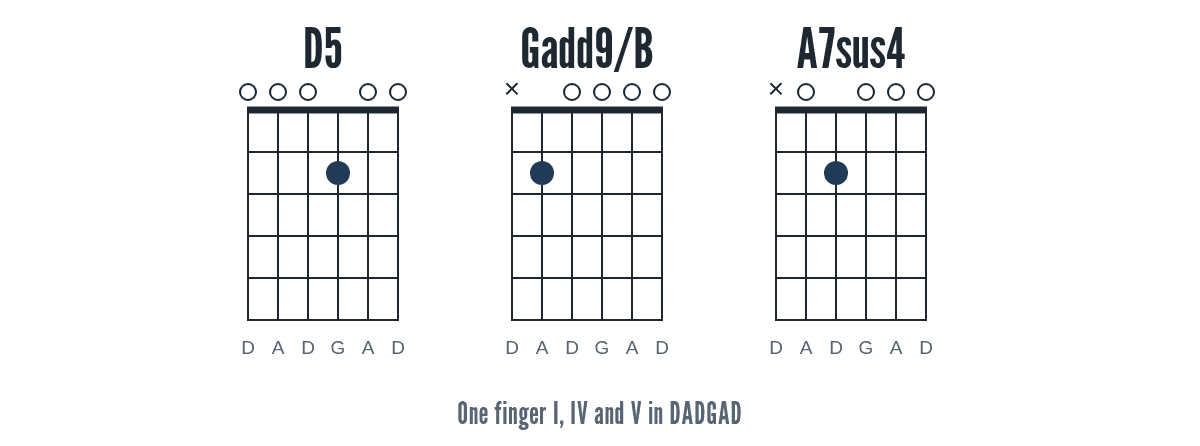
This is the fastest way to sound good in DADGAD. Martin Simpson’s Guitar Player lesson shows that you can get “rich harmony by merely fretting one note with your index finger.” In the key of D, the I, IV and V chords are D, G and A, and here each one is a single finger on the 2nd fret.
For the I, put your index finger on the G string: D5, 000200. Move it to the A string and skip the low D for Gadd9/B, x20000, which has the B, the chord’s third, in the bass. Move it again to the D string, still skipping the low D, for A7sus4, x02000. Strum back and forth and the open strings fill in the rest.
Those open strings only ring if nothing touches them. Guitar Player’s tip is to “arch your fretting fingers so they don’t impede the open strings’ vibrations,” and Guitar World gives the same advice. Play on the very tip of your finger.
To hear what ringing open strings can do, listen to Ben Howard’s In Dreams, from I Forget Where We Were (2014). Wikipedia and MusicRadar both list it as a DADGAD song, and the Ultimate Guitar tab is fast fingerpicking against the open strings.

G And A Chords
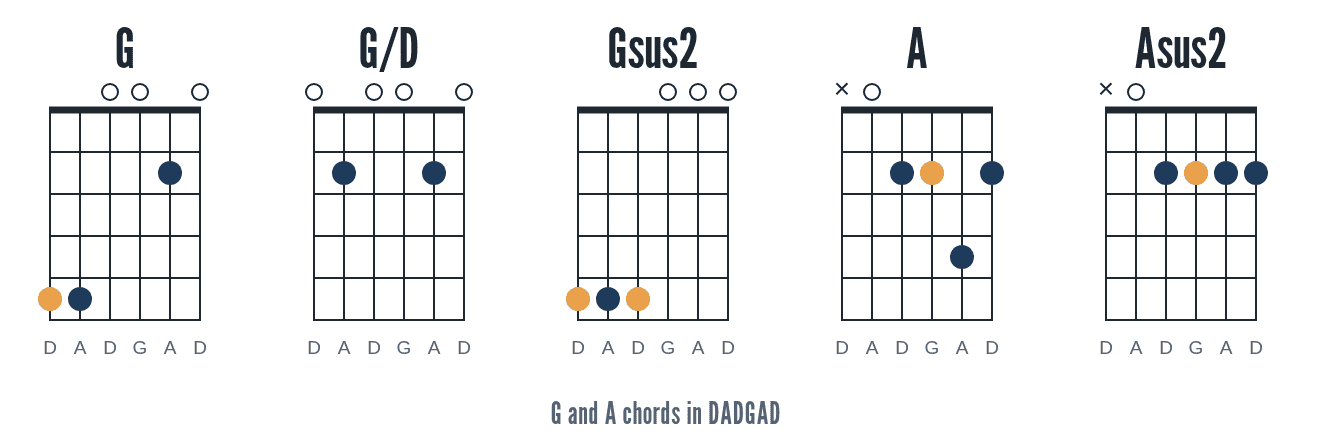
G and A are the IV and V in the key of D, so you’ll want fuller versions than the one finger shapes. The full G is 550020: lay your ring finger flat across the two low strings at the 5th fret and put your index finger on the 2nd fret of the 2nd string. That gives G D D G B D, a real G major with G in the bass, as both Killer Guitar Rigs and The Acoustic Guitarist chart it.
If that stretch is too much, try 020020, with two fingers on the 2nd fret of the two A strings. Guitar Gear Finder calls it G, but its lowest note is the open D, so its full name is G/D. Lift the 2nd string finger and you have MusicRadar’s Gadd9/D, 020000. And 555000 has no B at all, so it’s Gsus2, as Guitar World names it, not the G that Fundamental Changes calls it.
For A, play x02242: barre the top four strings at the 2nd fret with your index finger and add your pinky on the 4th fret of the 2nd string, which is the C#. Lift the pinky and you get MusicRadar’s Asus2, x02222.
Del Amitri’s Tell Her This, from Twisted (1995), is a strummed pop song in DADGAD with a capo, as Guitar World notes. Shapes from the Ultimate Guitar chords page include D 004200, G/D 020020, 020000 (which it calls G; it’s the Gadd9/D above) and 222000, the Em11 in the next section. The tab versions don’t agree on the capo fret, so match it to the recording.

Minor Chords And Cadd9
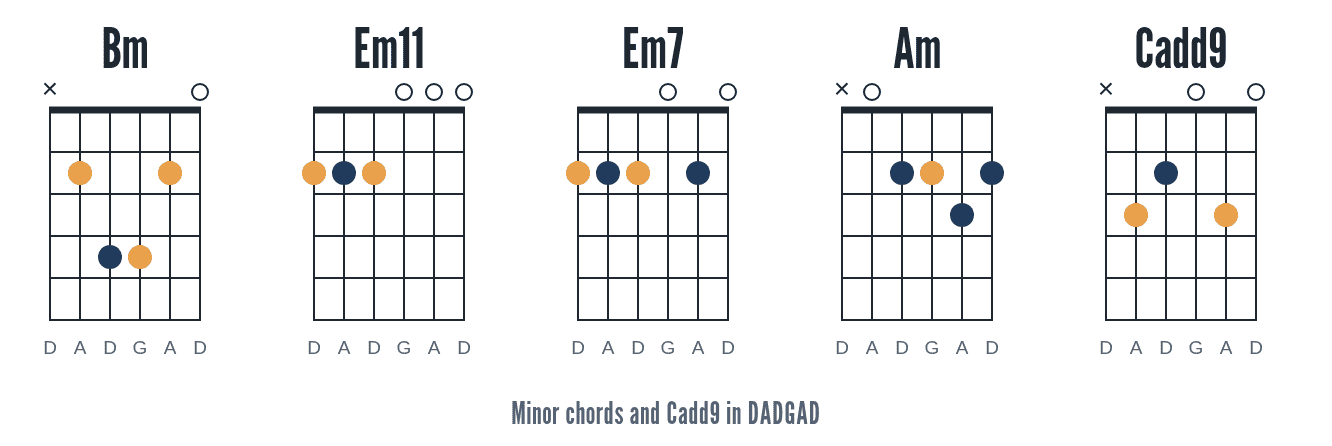
In the key of D, the minor chords you’ll meet most are Bm and Em. Bm is x24420: your index finger lies across strings 5 to 2 at the 2nd fret, and your ring finger and pinky go on the 4th fret of the D and G strings, with the high D ringing open on top. Leave the 2nd string open as well, x24400, and you get Bm7, a shape from Tom Strahle’s chord sheet.
Fundamental Changes and pickuptheguitar both call 222000 Em, and it’s the easiest minor shape here: three fingers, or a small barre, on the 2nd fret of the three low strings. The open strings add an A and a D on top, though, so the accurate name is Em11, which is what Guitar World calls it. Fret the 2nd string too, 222020, and you have the shape Killer Guitar Rigs names Em7.
Fundamental Changes adds an Am, x02232. Then there’s Cadd9, x32030, one of Jon Bishop’s five shapes: middle finger on the 3rd fret of the A string, index on the 2nd fret of the D string and ring finger on the 3rd fret of the 2nd string.
Guitar World says this Cadd9 can be heard in Jimmy Page’s fingerstyle classic Black Mountain Side, from the album Led Zeppelin (1969). The Ultimate Guitar tab, written for DADGAD, repeats that shape again and again.

Black Mountain Side Guitar Tabs
Moving Shapes Up The Neck
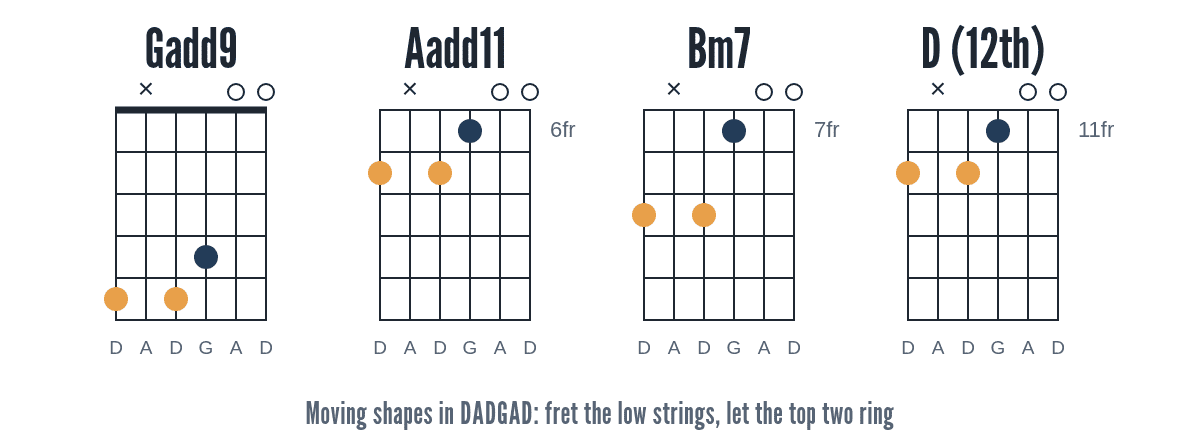
Here’s where DADGAD gets fun. Fret the root on the low D string and on the D string at the same fret, mute the A string, put a finger on the G string one fret lower, and let the top two strings ring. At the 5th fret that’s Gadd9, 5×5400. At the 7th it’s Aadd11, 7×7600, and at the 12th it’s a plain D, written with spaces because of the two digit frets: 12 x 12 11 0 0. Fundamental Changes plays the whole set, and Aadd11 is on Jon Bishop’s list of five.
For a minor chord, move the G string finger down one more fret, two below the root. That’s Bm7 at the 9th fret, 9×9700, also one of Bishop’s five. The open top strings add the extra colors, which is where names like add9, add11 and m7 come from.
Guitar Gear Finder adds barre shapes. A barre across all six strings is a sus4 chord: 222222 is Esus4, 555555 is Gsus4. Move the D major shape up with the barre as your nut for E at 226422 or G at 559755, or the Dm shape for Em at 225422 or Gm at 558755.
Kashmir by Led Zeppelin, from Physical Graffiti (1975), is a great example of a shape moving while open strings ring. In the Ultimate Guitar tab, its descending chord riff walks down the top four strings from the 12th fret to the 3rd and 2nd, and the open A on the 2nd string rings under every chord. Andy Guitar’s lesson covers the full DADGAD version. There are more of Page’s acoustic parts in my Led Zeppelin acoustic songs list.

Three DADGAD Chord Progressions

Shapes stick faster when you play them in a loop. Here are three, from easiest to hardest, all in the key of D. Give each chord four strums, then go round again.
- The one finger I, IV and V: D5 000200, Gadd9/B x20000 and A7sus4 x02000, Martin Simpson’s idea from above.
- D, A, Bm, G: a pop progression from Fundamental Changes. Use the chart’s shapes: D 004200, A x02242, Bm x24420 and G 550020, or G/D 020020 if the full G is a stretch.
- Bm7, Gadd9, Aadd11, D: the four key of D chords from the chord sheet that goes with Tom Strahle’s video above, with this page’s shapes: Bm7 9×9700, Gadd9 5×5400, Aadd11 7×7600 and D 004200. The sheet only lists the chords; the loop is my suggestion.
Want another key? D is home in DADGAD, but a capo moves every shape on this page. The Acoustic Guitarist’s examples are capo 2 for songs in E and capo 5 for songs in G.
Common Mistakes
- Playing your standard tuning shapes. After the retune they “have new sounds,” as MusicRadar says. Learn the chart’s shapes instead.
- Calling 000200 D major. It’s D5, with no F#. For D major, add the F# on the 4th fret of the D string: 004200.
- Retuning the wrong strings. Only strings 6, 2 and 1 go down; the G stays G. Lower the G to F# as well and you’re in open D instead.
- Tuning up instead of down. Every change goes down a whole step from standard, so no string is at risk.
- Fingers touching the open strings. Arch your fingers, play on your fingertips and keep your thumb centered on the back of the neck.
- Changing strings before you need to. The lowered strings lose about 21 percent tension, says The Acoustic Guitarist. Guitar Gear Finder says that’s not enough to change gauges; Killer Guitar Rigs suggests going from .009 to .010 or .011. Try your current set first.
- Living on the open strings and in D. Rocksmith lists leaning on the open strings as a common problem. Learn the moving shapes and use a capo for other keys.
Common Questions
Is DADGAD an open tuning?
Sources disagree. Guitar World’s Richard Barrett calls it “not actually an open tuning, rather an altered one,” because the open strings don’t sound a clear major or minor chord. Guitar Gear Finder calls it open because the strings form Dsus4, and lists Open Dsus4 tuning as another of its names.
Is DADGAD the same as open D?
Close, but no. The Acoustic Guitarist notes that only the 3rd string differs: G in DADGAD, F# in open D. That F# turns the open strings into a D major chord, which you can read about in my open D tuning guide.
Why is DADGAD called Celtic tuning?
Wikipedia links it to Celtic music because the open strings come close to the voicings of traditional Scottish and Irish pipe music. It isn’t only for folk, though: Wikipedia notes its use in rock and metal, Guitar World lists Jimmy Page’s White Summer next to Kashmir and Black Mountain Side, and Andy McKee’s Drifting shows it in modern tapping fingerstyle.
Is DADGAD bad for your guitar?
No. The Acoustic Guitarist says it’s “safe on any guitar, including classical.” The three lowered strings only get a little slacker.
The free two page PDF has every chord box from this page in its five groups, ready to print.
Conclusion
Start with the one finger I, IV and V, then add the true D, the full G and A, Bm and Em11. Once those feel easy, slide the moving shape up the neck and loop the three progressions. Give it a few days and the tuning stops feeling strange.
When you’re ready for whole songs, my list of famous songs in DADGAD tuning has plenty more to try.
Good luck and keep on rockin’!

Learning songs and licks?
Get a free sample of my book, From First Chord to First Solo: an original song on two chords, and the pentatonic shape most rock solos are built on.
If you found this article useful, you may want to save this pin below to your Guitar board.

Recent Posts
G, D, Em and C belong together. Wikipedia's page on G major lists them as the key's tonic (G), dominant (D), submediant (Em) and subdominant (C), which makes them the I, V, vi and IV chords. Play...
C standard takes every string on your guitar down two whole steps, so E A D G B E becomes C F A# D# G C. Wikipedia says hard rock and metal players use it "to achieve a heavier and deeper sound", and...